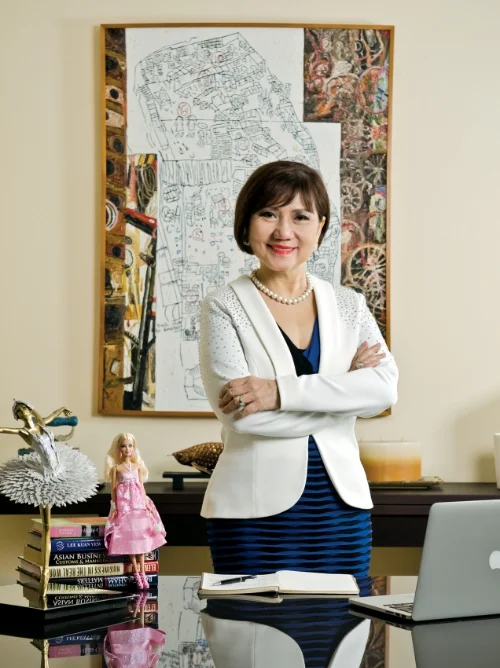
Entrepreneur Myrna T. Yao (Global FWN100™ '15) Shares Her Global Vision of Women in Business in Exclusive ABS-CBN Interview
Myrna T. Yao, CEO of Richprime Global Inc. (Global FWN™ '15) got her first entrepreneurial start at her family's sari-sari store and selling accessories to her classmates in Bicol. She now heads Richwell Trading, a leader in distribution and retail of branded consumer goods in the Philippines. Yao was recently interviewed by ABS-CBN where she shared meaningful insight on micro-entrepreneurship as the chairperson of the Philippine Commission on Women. In support of women's entrepreneurship, Yao shared, “if you have an idea, don’t wait, and if you’re afraid to make mistakes, mistakes will make you learn and will make you grow. So any problem that comes, you just have to face it and then you will learn from it and you will grow from it. And then you will be a better person and a better entrepreneur." Watch the video interview after the jump.
From selling simple blouses to going global, Myrna Tang Yao has a great success story to tell.
"I really wanted to be an entrepreneur since I was a child," said Yao, who is now the CEO of Richprime Global Inc.
Yao related that as a young girl, she helped look after their family's sari-sari store and sold accessories to her classmates in Bicol. The unrelenting female entrepreneur also sold different wares while growing up.
"Try to sell something whatever you can sell. One day you will know this is for you," Yao said in an exclusive interview on Mornings @ ANC.
With perseverance, Yao she founded Richwell Trading with a capital of just P5,000.
The company was then a franchise distributor of Goodyear Tires. Now, the company employs around 1,400 employees and offers a wide array of products.
The micro-entrepreneur-turned-tycoon shares her vision with “The Gift of a Dream: The GREAT Women Project."
“I have to write the book because my vision does not stop at the first level, or the second level. My vision is to make Filipina women grow their businesses to become SME [small and medium-sized enterprises] and global. I was defined as a micro entrepreneur. I don’t think I’m just a micro business, I’m a global business,” Yao said.
As the chairperson of the Philippine Commission on Women, Yao also pushed for "The Gender-Responsive Economic Actions for the Transformation of Women (GREAT Women) Project" which provided female entrepreneurs, particularly those in micro enterprises, a gender-responsive environment.
With this year's APEC meeting focusing on inclusive growth, Yao said she is happy that the agenda also focused on micro entrepreneurship.
“If you have an idea, don’t wait. Don't be afraid to make mistakes, mistakes will make you learn and will make you grow. So any problem that comes, you just have to face it and then you will learn from it and you will grow from it. And then you will be a better person and a better entrepreneur,” she said.
Read more here.
Story from ABS-CBN.
Photo from PhilippineTatler.com
President Obama Plays Opportunity Matchmaker For Filipina Engineer, Aisa Mijeno
Filipina Electrochemist Aisa Mijeno, inventor of SALt (Sustainable Alternative Lighting) an LED lamp that runs on seawater, recently met with President Obama for an opportunity of a lifetime at APEC (Asia-Pacific Economic Cooperation). Mijeno shared a stage with Obama and Alibaba Group Holding Ltd.’s Jack Ma where she introduced her unique lamp concept which avoids the hazards of a combustible fuel and can last up to six months. The platform shone a spotlight on various Filipino start-ups and will undoubtedly bring in funding and collaborative opportunities for Mijeno.
News story from Bloomberg Business.
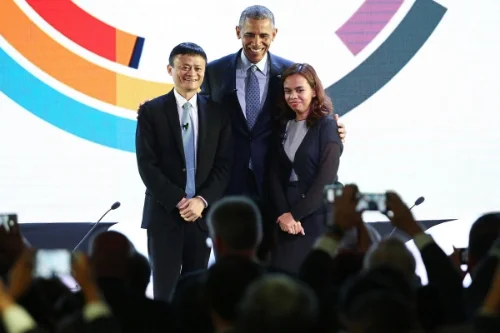
U.S. President Barack Obama (center), poses for a photograph with Alibaba billionaire Jack Ma and Aisa Mijeno, an engineer and social worker, at the APEC CEO Summit in Manila on Nov. 18, 2015. Photographer: Seong Joon Cho/Bloomberg
Until this week, Aisa Mijeno was yet another entrepreneur struggling to raise money for her startup in the Philippines. Then she got a call from the White House.
Now the 31-year-old engineer is getting global attention after President Barack Obama offered to play matchmaker for her company, which builds lamps that run on seawater. Mijeno, the co-founder of SALt, shared a stage Wednesday with Obama and Alibaba Group Holding Ltd.’s Jack Ma at the Asia-Pacific Economic Cooperation summit in Manila.
In a televised discussion about climate change before business and political leaders, the environmentalist pitched her marquee product: a lamp working off seawater, or a mixture of tap water and salt, to help people on the Philippines’ 7,000 islands who have difficulty accessing kerosene or who depend on candles.
“We also need a lot of support in terms of funding,” she said. “That’s our main challenge right now.”
To which Obama replied: “I’m serving as a matchmaker here.” The audience cheered.
Washington Call
Mijeno’s whirlwind started when she got a call from the White House asking her to join a panel that Obama would moderate. She thought it was a prank call. It turns out the U.S. president wanted to speak with the head of a startup, and his staff found her online, Mijeno said in an interview.
She was so excited she slept only three hours and almost fainted onstage during the conversation with Obama and China’s second-richest man.
Mijeno developed her idea for SALt, an acronym for Sustainable Alternative Lighting, after trekking in the mountains of Kalinga in the northern Philippines, where she saw people walk six hours every other day to buy lamp fuel. That’s when the electrochemist hit upon the idea of lighting that works off a resource covering 70 percent of the planet -- water.
Read the full story here.
News Story from Bloomberg Business
U.S. Efforts to Support Women's Economic Empowerment in APEC Economies FACT SHEET
U.S. Ambassador-at-Large for Global Women’s Issues Catherine Russell led the U.S. delegation to the Asia-Pacific Economic Cooperation (APEC) Women and the Economy Fora September 15 – 18, in Manila, Philippines. While in the Philippines, Ambassador Russell launched several U.S.-led initiatives and made joint commitments with other APEC officials that will empower women to play larger roles in the APEC economies.
The U.S. delegation included representatives from a number of U.S. agencies, including the Department of State, USAID, the Department of Labor, and the Small Business Administration. The United States was also represented by the private sector, including Google, Care.com, BSR, C&M International, Black Girls Code, The Filipina Women’s Network (FWN CEO & Founder Marily Mondejar), George Mason University, and ACG Inc.
Initiatives led by the United States focus on data collection, women’s entrepreneurship, women’s health and its relation to economic participation, leadership, and women in transportation. They are implemented with support from the State Department, as well as the U.S.-APEC Technical Assistance to Advance Regional Integration (US-ATAARI) activity, a project with funding and strategic direction from the State Department and technical oversight and management from USAID.
Fact Sheet Courtesy of the U.S. Department of State
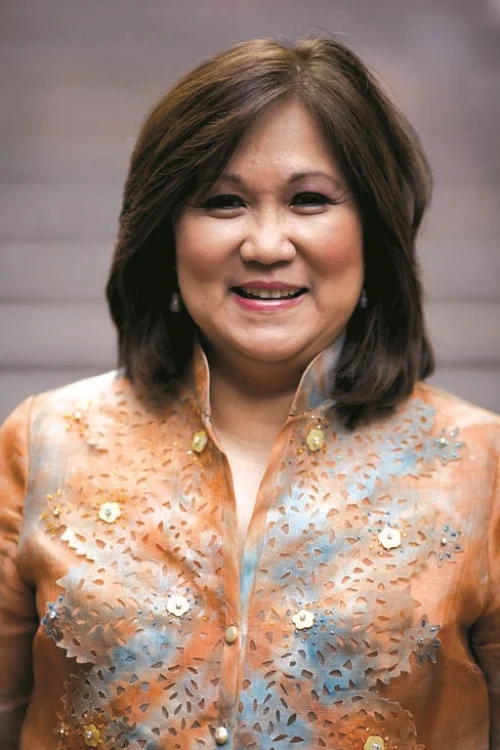
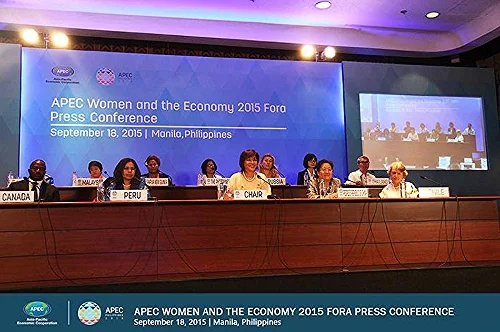
Photo shows Undersecretary Nora K. Terrado (front row, middle) reading the Women and the Economy Statement as the other Heads of Delegation listen in. Image Credit: http://apec2015.ph/
U.S. Ambassador-at-Large for Global Women’s Issues Catherine Russell led the U.S. delegation to the Asia-Pacific Economic Cooperation (APEC) Women and the Economy Fora September 15 – 18, in Manila, Philippines. While in the Philippines, Ambassador Russell launched several U.S.-led initiatives and made joint commitments with other APEC officials that will empower women to play larger roles in the APEC economies.
The U.S. delegation included representatives from a number of U.S. agencies, including the Department of State, USAID, the Department of Labor, and the Small Business Administration. The United States was also represented by the private sector, including Google, Care.com, BSR, C&M International, Black Girls Code, The Filipina Women’s Network (FWN CEO & Founder Marily Mondejar), George Mason University, and ACG Inc.
Initiatives led by the United States focus on data collection, women’s entrepreneurship, women’s health and its relation to economic participation, leadership, and women in transportation. They are implemented with support from the State Department, as well as the U.S.-APEC Technical Assistance to Advance Regional Integration (US-ATAARI) activity, a project with funding and strategic direction from the State Department and technical oversight and management from USAID.
Women and the Economy Dashboard
The 2015 APEC Women and the Economy Dashboard launched during the Fora. The Dashboard offers a data snapshot of women’s economic participation across the APEC region. Initiated by the United States in 2014, the Dashboard enables economies to mark and measure progress on 75 indicators. The Dashboard will help prioritize gender mainstreaming efforts, policy discussions, and capacity-building, with updates tracked every two years. The APEC Policy Support Unit’s analysis of the Dashboard highlights regional gaps and weaknesses based on the indicators where economies should develop and target activities beginning in 2016. The United States led the development of the framework for the Dashboard, which was agreed to by President Barack Obama and other APEC Leaders in November 2014.
Women’s Entrepreneurship in APEC (WE-APEC)
The United States officially launched the Women’s Entrepreneurship in APEC (WE-APEC) initiative, which aims to strengthen connectivity, collaborations, best practice-sharing, and regional trade between governments, entrepreneurs and the private sector throughout the APEC region. The initiative contains three main components:
- Economy-specific actions to strengthen eco-systems supporting women’s entrepreneurship based on findings from an initial region-wide report;
- An online platform that offers a detailed look at the ecosystem for women entrepreneurs in the APEC region, including a searchable directory that provides easy access to over 600 service providers for women entrepreneurs in APEC;
- Efforts to create a coordinating body between regional women’s entrepreneurship networks that will aim to improve trade, investment, and export oriented activities for women entrepreneurs in the region.
Healthy Women, Healthy Economies Policy Toolkit
The United States and the Philippines launched the Healthy Women, Healthy Economies Policy Toolkit, which offers actions that public and private sectors can take to enhance women’s economic participation by improving women’s health. This is the first time economies looked at the specific health issues impacting women’s economic participation, and it was developed in partnership with health, labor, gender, and economic area experts and private sector industry leaders. Recommendations were developed over the course of a year based on stakeholder meetings and a U.S.-funded literature review which grounded the recommendations in research. The Philippines and private sector companies such as Merck- Serono committed to piloting and measuring the impact of the toolkit beginning in 2016.
Women in Transportation
Women in Transportation (WiT) is a U.S-led effort to respond to the vast under-representation of women in each of the major transportation modes – trucking, rail, air, and maritime – as well as in related construction, maintenance, and ground-passenger transportation jobs. The effort has been recognized as an innovative practical initiative to advance women’s economic participation in male-dominated sectors.
The United States has led the development of a data framework and best practices report focused on women’s integration into the sector. The framework provides for benchmarking and tracking the participation and influence of women as transportation workers, entrepreneurs, leaders, and consumers. The framework will be unveiled by Transportation Ministers and highlighted at a special WiT Forum in October 2015.
Women’s Leadership
The United States joined other APEC economies in developing a domestic Individual Action Plan (IAP) to increase women’s leadership in both the public and private sectors. U.S. efforts focus on increasing women’s leadership representation in the federal workforce and executive branches. The U.S. IAP also focuses on programs to increase the number of women and girls studying science, technology, engineering, and math. The IAP is part of a project led by Japan to increase women’s regional leadership.
Background on APEC’s Work to Promote Women’s Economic Participation
The UN estimates that the APEC region loses upwards of $89 billion in GDP a year due to laws, policies, and social norms that inhibit women from being able to fully participate in and benefit from the economy. In 2011 under U.S. leadership, APEC elevated and energized its focus on women’s economic empowerment. Since then, APEC Ministers and Leaders from all 21 economies have agreed to take action to realize the full potential of women, focusing efforts on five key pillars impacting women’s economic empowerment: 1) access capital and assets; 2) access to markets; 3) skills, capacity building, and health; 4) women’s leadership, voice, and agency; and 5) innovation and technology.
Fact Sheet Courtesy of the U.S. Department of State
FWN CEO Marily Mondejar Selected to Join APEC Women & Economy as part of U.S. Delegation
We are pleased to announce that FWN Founder and CEO, Marily Mondejar, was recently selected to join the 2015 APEC Women and the Economy as part of the U.S. Delegation. She will be joining U.S. Ambassador-at-Large for Global Women’s Issues, Catherine M. Russell, the U.S. Department of State and the Secretary’s Office of Global Women’s Issues. This year’s APEC Women and the Economy meetings will take place in the Philippines from September 16-18th, 2015. At this year’s forum, the Philippines is highlighting three areas of importance: Women and Inclusive Business; Innovative: Women and the Global Value Chain; and Resilience, Women and Sustainable Development. Marily was nominated to participate as a representative in recognition of her leadership and work in these areas.
The delegation is headed by Ambassador Catherine M. Russell and the Secretary of State's Office of Global Women's Issues to participate in the 2015 APEC Women and the Economy Forum in Manila. Marily is one of 20 delegates comprised of senior officials from the U.S. Small Business Administration, Labor, Treasury, State and USAID. In addition, the delegation will have a select number of nominated representatives from the private sector and civil society organizations.
APEC Women and the Economy Theme and Priorities
Overview of the Women and the Economy agenda in APEC
What is the women’s agenda in APEC? The entire conversation on this vital program was concretized when, in 1996, the APEC founded the Women Leaders’ Network: an informal, dynamic network that brings together women leaders from all sectors to provide policy recommendations to APEC officials. Through this landmark development, the Action Program of APEC introduced the gender dimension, where leaders put special emphasis on the women’s participation in APEC.
In 1998, the first APEC Ministerial Meeting on Women held in Makati City, Philippines led to the publication of the Framework for the Integration on Women in APEC the following year. It recognized the nature of gender equality as a cross-cutting issue in APEC. The Framework outlines a practical and systematic approach on how to fully integrate women into the mainstream APEC processes and activities.