Filipino Bakery Workers Win $15 Million Human Trafficking Suit
Eleven Filipino bakery workers say they won $15 million in damages in a human trafficking lawsuit against a couple who they said forced them to do housework after arriving in the United States and paid them a meagre wages. Asian Americans Advancing Justice-Los Angeles said Friday that a federal judge in Los Angeles granted the judgment on behalf of the workers last week. News story from The Associated Press via Toronto Sun.
Eleven Filipino bakery workers say they won $15 million in damages in a human trafficking lawsuit against a couple who they said forced them to do housework after arriving in the United States and paid them a meagre wages.
Asian Americans Advancing Justice-Los Angeles said that a federal judge in Los Angeles granted the judgment on behalf of the workers last week.
The workers were brought to the U.S. on visas to work at L'Amande French Bakery or to work as nannies. Once here, they said bakery owners Analiza and Goncalo Moitinho de Almeida had them work at least 13 hours a day for scant pay.
Some workers who complained said they were fired.
A message seeking comment was left for the bakery owners' lawyer, Joshua Kimura.
News story from The Associated Press via Toronto Sun.
GABRIELA USA Joins One Billion Rising to Amplify Voices Against Forced Migration, State Violence and Displacement
Unite to end all forms of violence against women! In preparation for the 106th Anniversary of the International Working Women’s Day Celebration and the 3rd National Congress on March 19-20, “ABANTE! (Advance) Women defend the people's democratic rights for dignity and self determination. To register for GABRIELA USA’s national congress, please visit www.abantegabriela.org.
For Immediate Release
February 15, 2016
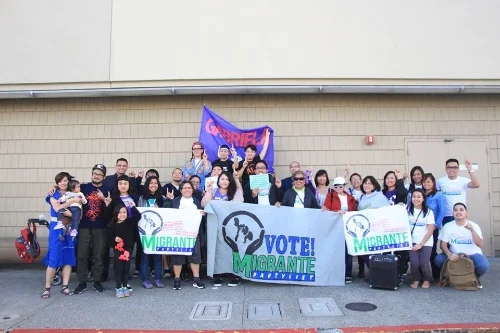
In preparations for the 106th Anniversary of the International Working Women’s Day Celebration and the 3rd National Congress on March 19-20, “ABANTE! (Advance) Women defend the people's democratic rights for our dignity and self determination!”, GABRIELA USA members and allies in New York City, Seattle, the San Francisco/Bay Area, Portland and Los Angeles held successful actions in hubs of Filipino American communities and populous points of urban cities. Actions were intergenerational with immigrant workers, youth and students and community organizations; the uniting call was to end all types of violence against women!
Across the country, chapters of GABRIELA USA gathered and danced with a mission to end violence against women with forced migration, state violence and displacement in particular. Highlighting domestic violence and campaigns of wage theft, trafficking of Filipino teachers, and opposition to the Enhanced Defense Cooperation Agreement (EDCA), GABRIELA USA members drew attention to violence that Filipino women and children face, in the U.S. and the Philippines.
From the U.S. to the Philippines to Palestine and throughout the globe, we are witnessing the ever-worsening crisis of a global imperialist system. In the U.S., Filipinos are marching alongside Black people to resist racially targeted police violence on Black people, while police officers are not held accountable for their actions. Meanwhile, displacement of working-class families in urban communities have been rampant despite the overwhelming wealth being funneled into major cities in the U.S. Furthermore, there are increasing deportations of migrant families who seek refuge and a dignified life in the U.S. In the Philippines, the Lumad are resisting plunder of ancestral lands and defending the rights of indigenous children for a culturally relevant education.
As imperialist interests are increasing in its aggression, working-class women and their families have to bear the costs and impacts of a system that profits from the exploitation of the majority. It is our duty to raise the analysis on the issue of violence against women (VAW), expanding beyond VAW as a gender issue, and highlighting the economic, political, and cultural aspects by connecting how imperialism perpetuates and worsens VAW in all its forms.
To register for GABRIELA USA’s national congress, please visit www.abantegabriela.org.
Filipina Trafficking Survivors Launch Damayan Cleaning Coop To Combat Exploitation
A story of resilience and tenacity. Ex-trafficked Filipina domestic worker Judith Daluz is turning her fate around. Judith recently started her own cleaning business, Damayan Cleaning Cooperative, a worker-owned cooperative supported by New York’s city council's Worker Cooperative Business Development Initiative, a $1.2 million dollar fund directed to 11 organizations with experience incubating cooperatives in low-income communities of color. News story from YesMagazine.org.
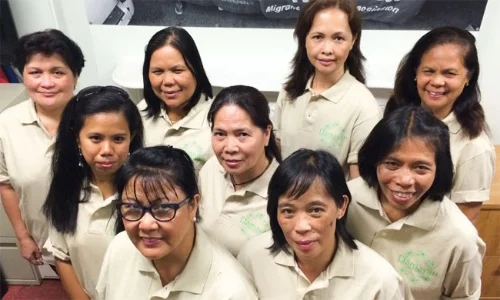
Judith Daluz, Founder of Damayan Cleaning Coop is pictured front row, right.
Image credit: Damayan Cleaning Coop.
In 2013, Judith Daluz was a nanny making $650 a week, waiting for her four children to arrive from the Philippines. With her hard-earned savings, she had started paying $1,500 a month for a one-bedroom apartment in the New York borough of Queens that she hoped would be big enough for all of them. She hadn’t seen her children in years.
In 2006, Daluz was trafficked to the United States as a domestic worker. Now, as a free, documented worker, she was able to bring her children to live with her—but worried about how she would support them.
Organizers at the Damayan Migrant Workers Association, a member-led organization helping Filipino workers understand and protect their rights, realized that many of its members had similar concerns. Established in 2002, the grassroots organization, led by Filipino survivors of human trafficking and other low-wage workers, has helped dozens escape abusive conditions, recover stolen wages, and pursue T visas, which allow trafficking survivors to remain in the United States. But many of Damayan’s members, once freed from forced labor, found themselves in another troubling, if less shocking situation: Even with better working conditions, they often had little job security and earned a pittance.
In June 2014, members of Damayan’s board heard that New York’s city council had set aside $1.2 million to fund a Worker Cooperative Business Development Initiative. The city directed money to 11 organizations with experience incubating cooperatives in low-income communities of color, allowing them to expand their reach to new entrepreneurs. It was the largest investment in cooperatives by any city government in U.S. history. In the last year, the initiative has helped facilitate the launch of 21 new cooperatives, provided guidance for 19 new worker-owned businesses that will open in 2016, and assisted 26 existing cooperatives. By the end of 2016, there will be 66 new worker-owned cooperatives in New York City. One of them is the new Damayan Cleaning Cooperative.
With support from an organization participating in the city’s initiative, Damayan launched its worker-owned cooperative in September 2015—a natural next step from their anti-trafficking and anti-exploitation work. Damayan’s members envisioned an enterprise that both protects their rights as workers and is guided not by profit but by their needs and those of the community.
Read the whole story here.
Story courtesy of YesMagazine.org