The Right to U.S. Citizenship For Children Born on American Soil is Being Challenged
For over a century, U.S. law has declared that every child born on American soil is born with the same rights as every other U.S. citizen.
But that right is being challenged.
On Sunday, Republican presidential candidate Donald Trump released a series of immigration proposals, including bringing an end to birthright citizenship. This statement in particular is receiving extraordinary media attention — even as a policy idea that’s been dredged up time and again through the years, largely to stir up anti-immigrant sentiment.
News story courtesy of Advancing Justice | AAJC
For over a century, U.S. law has declared that every child born on American soil is born with the same rights as every other U.S. citizen.
But that right is being challenged.
On Sunday, Republican presidential candidate Donald Trump released a series of immigration proposals, including bringing an end to birthright citizenship. This statement in particular is receiving extraordinary media attention — even as a policy idea that’s been dredged up time and again through the years, largely to stir up anti-immigrant sentiment.
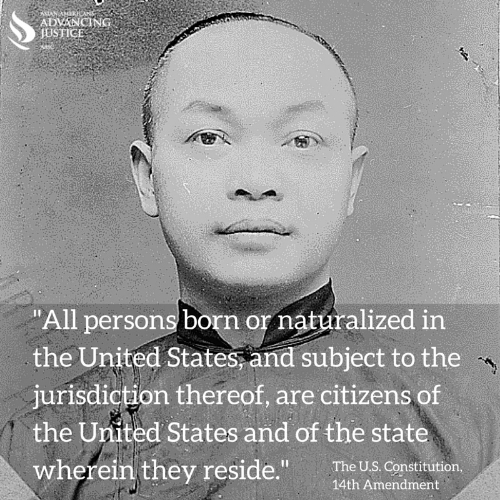
For Asian Americans, this is hardly a new issue, and the inflammatory xenophobic language that comprises so many arguments to end birthright citizenship are painfully familiar. After all, the person who brought the question of his citizenship to the Supreme Court in 1897 was Asian American, born in San Francisco to Chinese immigrant parents.
Professor Erika Lee, director of the Immigration History Research Center at the University of Minnesota and author of the book “The Making of Asian America: A History” offers up a short lesson in the New York Daily News this week, telling the story of Wong Kim Ark, the 24-year-old who insisted he was a U.S. citizen based on his birth as granted by the Fourteenth Amendment.
While this claim seems straightforward today, it was extraordinary for its time. The Chinese Exclusion Act, the first significant legislation passed to keep a specific ethnic group from entering the country and naturalizing, was in effect, and the U.S. government argued that Wong Kim Ark could not be a U.S. citizen because his parents were not and could not become U.S. citizens.
The Supreme Court ruled in favor of Wong Kim Ark. At a time when sentiment against Chinese immigrants was high, this decision in favor of a Chinese-American born on American soil set the precedent that children born in the United States, even to parents not eligible to become citizens, were nonetheless citizens themselves under the 14th Amendment of the U.S. Constitution. This precedent has endured for over 100 years.
Read more here.
News story courtesy of Advancing Justice | AAJC
Filipino World War II Veterans Will Get Easier Path To Reunite With Family
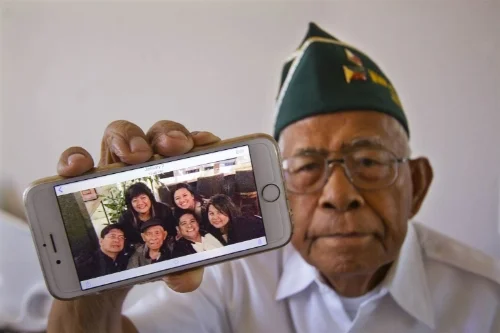
Filipino-American World War II veterans who have been waiting for years to bring their family members to the U.S. will soon be able to do so through a new policy, the Obama administration announced on Wednesday.
News story courtesy of HuffPost Politics
Photo credit: Angry Asian Man Blog
Filipino-American World War II veterans who have been waiting for years to bring their family members to the U.S. will soon be able to do so through a new policy, the Obama administration announced on Wednesday.
The policy, announced along with a spate of other recommendations to improve the legal immigration system, will help the thousands of American citizens and legal permanent residents of Filipino descent who fought for the U.S. in World War II and are now trying to help family members come to the country legally. Many of those veterans are elderly and need family care or company, but their families face long wait times -- sometimes more than 20 years -- to immigrate to the U.S.
The Department of Homeland Security will work with the State Department to create a program that allows certain family members of the veterans to come to the U.S. under parole status on a case-by-case basis, rather than through the general family immigration process.
"These are people who are eligible for an immigration visa by virtue of their U.S. citizen family member, who also happens to be a veteran who served in the second world war," a White House official told The Huffington Post. "But because the family immigration system is so backlogged, it can take decades for them to actually get a visa."
The new policy is one of many ways the administration is seeking to change the immigration system through executive actions, as President Barack Obama announced last November. Although the most-noticed portion of the executive actions -- programs to allow some undocumented immigrants to remain in the U.S. and work -- are blocked in the courts, the administration is moving ahead with other changes and recommendations.
To read more, click here.
News story courtesy of HuffPost Politics
EVENT: Meet Senator Mazie Hirono, Her New Bill Would Make It Easier for Children of Filipino World War II Veterans To Get Visas
“Time is running out for the diminishing number of Filipino World War II veterans who fought and sacrificed alongside American servicemen,” Hirono said in a statement. “We as a nation made a promise to these veterans that must be kept.”
Senator Mazie Hirono looking out for Filipinos! A bill introduced by Sen. Hirono and co-sponsored by Sen. Brian Schatz would make it easier for children of Filipino World War II veterans to get visas.
“Time is running out for the diminishing number of Filipino World War II veterans who fought and sacrificed alongside American servicemen,” Hirono said in a statement. “We as a nation made a promise to these veterans that must be kept.”
More than 260,000 of these veterans were offered U.S. citizenship for their service, but the benefit did not extend to their children, separating thousands of families for decades. Now, veterans must file for a family visa, but it can take more than 20 years for these applications to be reviewed.
To read more, click here.
MEET Senator Hirono at a reception on March 28 (2-4pm) at the Crystal Jade, Embarcadero San Francisco.