ANNOUNCEMENTS Raissa Alvero ANNOUNCEMENTS Raissa Alvero

The Strong Filipina Women Standing Up Against Philippine President Duterte

"With little external pressure coming anytime soon, President Duterte only faces internal opposition from two political figures – both are women, and both are well placed and well equipped to combat the macho autocrat." News story from The Guardian.
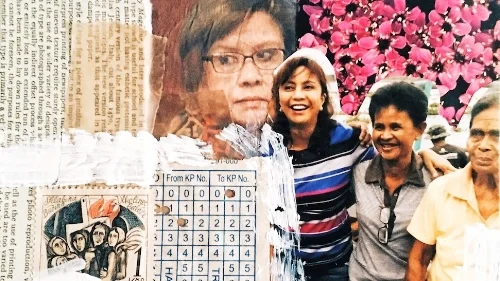
Image credit: Aaron Favila/AP

Image credit: Aaron Favila/AP

The president of the Philippines, Rodrigo Duterte, has not even been in power for six months, but it already seems like far too long. His constant amateur dramatics on international affairs generate catchy headlines, and a calamitous war on drugs that has cost more than 5,000 people their lives draws attention, if not strong enough condemnation. With little external pressure coming anytime soon, the strongman only faces internal opposition from two political figures – both are women, and both are well placed and well equipped to combat the macho autocrat.

The vice-president, Leni Robredo, resigned from her position in the cabinet this week and now openly presents herself as a desperately needed opposition force. Robredo has joined the good fight, alongside Senator Leila de Lima, who for the past six months has faced a tirade of misogynist abuse and a smear campaign that is only worth repeating in order to bring shame on Duterte and his acolytes.

Wild accusations that she is “a drug lord” who operated through prisons, and threats to broadcast a supposed sex tape of her in the Senate are just the tip of the iceberg. But, together, Robredo and De Lima represent all that is left of liberal courage in Filipino politics.

It’s a development that recalls the country’s idiosyncratic relationship with women in politics. While Robredo and De Lima are strong characters they also have plenty of good role models. Many have only recently paid attention to the country because of Duterte’s insults and the banal comparisons to Trump-popularism, but it is important to recall the rich history of Filipinas in politics, not least in replacing previous dictators.

When Ferdinand Marcos was overthrown in the People Power revolution in 1986, Cory Aquino became one of the world’s first female heads of state. The uncanny parallels between the two widows – Robredo and Aquino – are impossible to ignore. Aquino’s husband, Benigno Aquino Jr, was assassinated on the tarmac at Manila airport (now named after him) when returning from exile in 1983. Robredo lost her husband Jesse, then interior secretary, in 2012 in a plane crash.

Despite the Philippines holding on to archaic, heavily Catholic-influenced policies on female reproductive rights, the country has had more female leaders than most nations and many prominent women in public life. In 2001 Gloria Arroyo became the second female president (after having served as vice-president) and in 2005 was named by Forbes as the fourth most powerful woman in the world. The recent death of Miriam Defensor Santiago known as the Iron Lady of Asia, who even Duterte acknowledged, “ate death threats for breakfast”, was widely mourned. And even Imelda Marcos has to be acknowledged for her influence, and remains an elected member of Congress.

Yet despite such a feminist pedigree, in 2013 the World Economic Forum ranked the Philippines fifth (out of 137) in its Gender Gap Index, and in Duterte the country has elected an openly chauvinist candidate who has joked about rape. By wolf-whistling female journalists in televised press conferences, Duterte has been willing to risk considerable political wrath from women. The media and his supporters have either lapped it up or ignored it, though. But Duterte will at least have to respect De Lima and Robredo in private from now on, if he is to see off the considerable challenge they represent.

Paradoxically, De Lima was the one person who perhaps could have saved Duterte from himself and the country more pain. Her attempt to investigate the drug war could have led to reforms, if not staved off the growing spectre of a warrant from the ICC for his arrest. Alex Whiting, a Harvard law professor and former ICC investigator, has argued that the ICC should begin looking at the killings. The ICC prosecutor Fatou Bensouda could well be the next woman Duterte has to take seriously rather than just throw insults at.

For now Robredo and De Lima can lead an opposition on two fronts. First to the misogyny – a bipartisan social media campaign has already begun to counter the army of Duterte trolls and fake news stories bred by Duterte supporters. Second, in the Supreme Court, where they can oppose the decision to allow a hero’s burial for Ferdinand Marcos. Robredo has already taken to passive-aggressively shaming him on this issue through Twitter.

News story from The Guardian.

Read More
OPINION Raissa Alvero OPINION Raissa Alvero

OPINION: Philippine President Duterte Era to Women: Put Up or Shut Up

"To be a woman and occupy public office is to have one’s body parts ogled at by the other men in the room, or be dismissed as a joke. To be a woman in public service is to risk having one’s private life being trotted out and discussed salaciously if you say something out of line. The message is: put up or shut up." News story from Esquire Magazine Philippines.
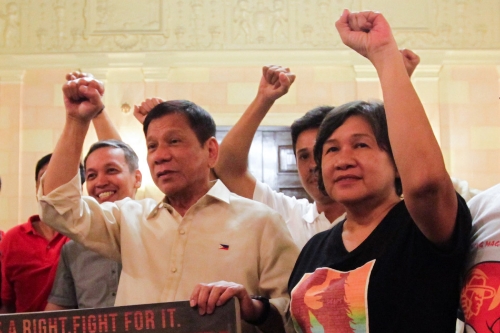
Image credit: Illustrator Sasha Martinez

Image credit: Illustrator Sasha Martinez

Duterte Era to Women: Put Up or Shut Up

Has government embraced a policy of undermining the authority of women elected into positions of power?

By Christine Lao

During the public commemoration of the third anniversary of Typhoon Yolanda in Tacloban City, President Rodrigo Duterte publicly criticized the length of Vice President Leni Robredo’s hemline, joked about checking out the Vice President’s legs, and asked her about rumors that he claims to have heard about her “love life.” The President defended his objectification of the Vice President, saying it was necessary to “make people laugh.” Vice President Robredo herself dismissed the matter, saying that, although the remarks were inappropriate there were “larger and more urgent issues we confront as a nation”—mainly, the Supreme Court’s decision to allow former President Ferdinand Marcos to be buried in the Libingan ng mga Bayani.

Shouldn’t we take the President’s conduct toward Robredo more seriously? During his state visit to China, the President was accompanied, not by Robredo, but by Ferdinand “Bongbong” Marcos Jr., who had lost the vice presidency to Robredo and currently occupies no government post. The son of the dictator, Marcos Jr. has a pending electoral protest against Robredo. In China, the President told an audience of Filipinos in Beijing that if Marcos, Jr. wins his protest, “maybe we’ll have a new vice president.”

Likewise alarming is the manner in which government is conducting its investigation into Senator Leila De Lima’s alleged links to the drug trade. The ongoing investigations in the House of Representatives, where President Duterte’s party has secured a “super majority,” are an embarrassment and an outrage. At last Thursday’s hearing, congressmen asked demeaning questions focused on De Lima’s personal affairs and private life, and not on her alleged drug links at the New Bilibid Prison.  We must not forget that it was the President himself who announced that he had a sex tape of Senator De Lima and a former member of her staff. Nor should we forget that this announcement was preceded by a Senate probe on extrajudicial killings, which De Lima had initiated as chair of the Senate Committee on Justice.

All these suggest a pattern of behavior that demeans women to undermine their presence in the public realm and ultimately, exclude them from it. To be a woman and occupy public office is to have one’s body parts ogled at by the other men in the room, or be dismissed as a joke. To be a woman in public service is to risk having one’s private life being trotted out and discussed salaciously if you say something out of line. The message is: put up or shut up.

Sadly, the highest leaders of the land, appear to have modeled this behavior all too well.

Read the rest of the article here
News story from Esquire Magazine Philippines

Read More
ANNOUNCEMENTS Raissa Alvero ANNOUNCEMENTS Raissa Alvero

GABRIELA USA Welcomes President Duterte Joining Millions of Women Calling For Change

GABRIELA USA released a statement highlighting the key concerns of the women’s sector upon conclusion of its National Women’s Summit in Davao City, Mindanao.  Attendees of the summit drew up a Women’s Agenda to reflect the calls that the women’s sector urges President Duterte to take up in his first 100 days of administration and beyond.  The Women’s Agenda for CHANGE outlines six key points: C in CHANGE stands for [C] Comprehensive social services, [H] Human Rights and social justice, [A] Anti-discrimination and anti-violence on women and children, [N] National Sovereignty, [G] Genuine agrarian reform and national industrialization and [E] Environmental protection. 

 Liza Maza, former Chairperson of GABRIELA and Congressional Representative of Gabriela Women’s Party, appointed as Lead Convenor for the National Anti-Poverty Commission. Image credit: GABRIELA USA

 Liza Maza, former Chairperson of GABRIELA and Congressional Representative of Gabriela Women’s Party, appointed as Lead Convenor for the National Anti-Poverty Commission. Image credit: GABRIELA USA

GABRIELA USA
For Immediate Release
Contact: Irma Salvatierra Bajar, Chairperson, GABRIELA USA, gabrielawomen@gmail.com

GABRIELA USA welcomes Rodrigo Duterte as the newly inaugurated 16th President of the Philippines, and joins millions of women in calling for CHANGE.

“Women in the Philippines suffered unemployment, landlessness, violence and state sponsored repression for six long years under the previous Aquino administration and we are hopeful that President Duterte will address the concerns of women and their communities,” stated GABRIELA USA Chairperson Irma Bajar. 

GABRIELA defined the key concerns of the women’s sector upon conclusion of its National Women’s Summit in Davao City, Mindanao. The summit brought together 250 women from across the Philippines, representing such sectors as peasants, workers, urban poor, professionals, and indigenous women.  Attendees of the summit drew up a Women’s Agenda to reflect the calls that the women’s sector urges President Duterte to take up in his first 100 days of administration and beyond.  The Women’s Agenda for CHANGE outlines six key points: C in CHANGE stands for [C] Comprehensive social services, [H] Human Rights and social justice, [A] Anti-discrimination and anti-violence on women and children, [N] National Sovereignty, [G] Genuine agrarian reform and national industrialization and [E] Environmental protection.

GABRIELA USA applauds Duterte’s willingness to dialogue with people’s organizations to bring about change and his appointment of progressive leaders to several positions within his administration. The recent appointment of Liza Maza, the former Chairperson of GABRIELA and Congressional Representative of Gabriela Women’s Party, as Lead Convenor for the National Anti-Poverty Commission, will serve as an important voice in government to defend and uphold the interests of women and of the Filipino people in general.

“This is an exciting time for our kababayan--not only because there are progressives serving in important roles in the new administration but because of the resumption of peace negotiations between the Government of the Philippines and the National Democratic Front of the Philippines,” stated Bajar.  “We must continue to support the peace negotiations because through those talks, the roots of our people’s suffering can be addressed and we can build a truly independent Philippines where people can have decent livelihood and where the rights of the people are upheld.”

#WomenWantCHANGE

Read More