Silverado to Pay $80,000 to Settle EEOC Pregnancy Discrimination Lawsuit
Silverado, a network of memory care, at-home care, and hospice care centers, will pay $80,000 and provide other relief to settle a pregnancy discrimination lawsuit brought by the U.S. Equal Employment Opportunity Commission (EEOC), the agency announced today. Silverado discriminated against Shaquena Burton, a caregiver at the Silverado Oak Village facility in Menomonee Falls, Wisc., when it fired her rather than accommodate her pregnancy-related medical restrictions.

FOR IMMEDIATE RELEASE
Jan. 29, 2018
SILVERADO TO PAY $80,000 TO SETTLE EEOC PREGNANCY DISCRIMINATION LAWSUIT
Residential Care Provider Refused to Put Pregnant Worker on Light Duty and Fired Her Instead, Federal Agency Had Charged
MILWAUKEE, Wis. – Silverado, a network of memory care, at-home care, and hospice care centers, will pay $80,000 and provide other relief to settle a pregnancy discrimination lawsuit brought by the U.S. Equal Employment Opportunity Commission (EEOC), the agency announced today.
According to the EEOC’s suit, Silverado discriminated against Shaquena Burton, a caregiver at the Silverado Oak Village facility in Menomonee Falls, Wisc., when it fired her rather than accommodate her pregnancy-related medical restrictions, which it could have done by putting her on light duty assignment.
Such alleged conduct violates Title VII of the Civil Rights Act of 1964, as amended by the Pregnancy Discrimination Act, which protects employees from discrimination based on pregnancy. The EEOC filed suit (EEOC v. Silverado Menomonee Falls, LLC d/b/a Silverado Oak Village and Silverado Senior Living, Inc., Case No. 2:17-cv-1147) in U.S. District Court for the Eastern District of Wisconsin in Milwaukee on August 22, 2017, after first trying to reach a pre-litigation settlement through its conciliation process.
The consent decree settling the suit, entered by U.S. District Judge J.P. Stadtmueller on January 29, prohibits future discrimination, prohibits retaliation, and provides that Silverado will pay $80,000 to Burton. Silverado must also post notices of the settlement, revise its anti-discrimination and record-keeping policies, report any requests for light duty or other job modifications periodically to the EEOC, and train its managers regarding those rights, obligations, and procedures.
“We thank Silverado for its commitment to settle this case before the sides incurred significant costs and its willingness to ensure a level playing field for its pregnant employees seeking job modifications, including light duty work, otherwise available to non-pregnant employees,” said EEOC Chicago Regional Attorney Gregory M. Gochanour. “The EEOC will continue to enforce the federal laws so that all pregnant employees have the same opportunities as non-pregnant employees to contribute to our thriving economy,” said Julianne Bowman, the EEOC’s district director for the Chicago District Office.
The EEOC advances opportunity in the workplace by enforcing federal laws prohibiting employment discrimination. More information is available at www.eeoc.gov. Stay connected with the latest EEOC news by subscribing to our email updates.
###
For media inquiries:
(202) 663-4191
newsroom@eeoc.gov
EEOC Releases Fiscal Year 2017 Enforcement and Litigation Data
The U.S. Equal Employment Opportunity Commission (EEOC) today announced that 84,254 workplace discrimination charges were filed with the federal agency nationwide during 2017, and secured $398 million for victims through voluntary resolutions and litigation. The EEOC resolved 99,109 charges in FY 2017 and reduced the charge workload by 16.2 percent to 61,621, the lowest level of inventory in 10 years.
FOR IMMEDIATE RELEASE
Jan. 25, 2018
EEOC RELEASES FISCAL YEAR 2017 ENFORCEMENT
AND LITIGATION DATA
Agency Reduces Charge Workload to Lowest Level in 10 Years;
Obtains Nearly $400 Million for Discrimination Victims
WASHINGTON — The U.S. Equal Employment Opportunity Commission (EEOC) today announced that 84,254 workplace discrimination charges were filed with the federal agency nationwide during fiscal year (FY) 2017, and secured $398 million for victims in the private sector and state and local government workplaces through voluntary resolutions and litigation. The comprehensive enforcement and litigation statistics for FY 2017, which ended Sept. 30, 2017, are posted on the agency’s website.
The EEOC resolved 99,109 charges in FY 2017 and reduced the charge workload by 16.2 percent to 61,621, the lowest level of inventory in 10 years. The agency achieved this by deploying new strategies to more efficiently prioritize charges with merit, more quickly resolve investigations, and improve the agency’s digital systems. The agency handled over 540,000 calls to its toll-free number and more than 155,000 inquiries in field offices, reflecting the significant public demand for the EEOC’s services.
“Over the past year, the EEOC has remained steadfast in its commitment to its core values and mission: to vigorously enforce our nation’s civil rights laws,” said EEOC Acting Chair Victoria A. Lipnic. “The results for the last fiscal year demonstrate exactly that.”
The FY 2017 data show that retaliation was the most frequently filed charge filed with the agency, followed by race and disability. The agency also received 6,696 sexual harassment charges and obtained $46.3 million in monetary benefits for victims of sexual harassment. Specifically, the charge numbers show the following breakdowns by bases alleged, in descending order:
• Retaliation: 41,097 (48.8 percent of all charges filed)
• Race: 28,528 (33.9 percent)
• Disability: 26,838 (31.9 percent)
• Sex: 25,605 (30.4 percent)
• Age: 18,376 (21.8 percent)
• National Origin: 8,299 (9.8 percent)
• Religion: 3,436 (4.1 percent)
• Color: 3,240 (3.8 percent)
• Equal Pay Act: 996 (1.2 percent)
• Genetic Information: 206 (.2 percent)
These percentages add up to more than 100 because some charges allege multiple bases.
EEOC legal staff filed 184 merits lawsuits alleging discrimination in fiscal year 2017. The lawsuits filed by the EEOC included 124 individual suits and 30 suits involving multiple victims or discriminatory policies and 30 systemic discrimination cases. At the end of the fiscal year, the EEOC had 242 cases on its active docket. The EEOC achieved a successful outcome in 90.8 percent of all suit resolutions.
The EEOC advances opportunity in the workplace by enforcing federal laws prohibiting employment discrimination. More information is available at www.eeoc.gov. Stay connected with the latest EEOC news by subscribing to our email updates.
###
For media inquiries:
(202) 663-4191
newsroom@eeoc.gov
National Women's History Project 2018 Sponsorship & Advertising Opportunities
To help encourage year-long celebration of the 2018 theme NEVERTHELESS SHE PERSISTED, Women Who Fight All Forms of Discrimination Against Women, the National Women's History Project is hosting two Honoree luncheons and publishing a 2018 Honoree Tribute Magazine. Support women whose determined persistence has help create a better world today!

To help encourage year-long celebration of the 2018 theme NEVERTHELESS SHE PERSISTED, Women Who Fight All Forms of Discrimination Against Women, the National Women's History Project is hosting two Honoree luncheons - one in Washington, DC, in March, and the second in Oakland, CA, in August.
More information on sponsorship opportunities here.
2018 Honoree Tribute Magazine
In recognition of the 2018 Honorees, as well as other women, whose lives exemplify the 2018 theme, the National Women's History Project is publishing a 2018 Honoree Tribute Magazine.
This full-color magazine with an 7.5" x 10" format will include bios and images of the 2018 National Women's History Honorees, recognition of other special women, as well as women's history books and organizations, and a brief history of the National Women's History Project, as well as an acknowledgement of our Advertising Sponsors.
If you have a special person or organization in mind please consider honoring them in the 2018 Honoree Tribute Magazine.
Iranian-American Tech Entrepreneur Ali Partovi Becomes Second-Class Citizen Under Visa Waiver Program
Recently, President Obama cancelled the Visa Waiver Program in 38 countries. Now, individuals from these 38 countries who hold dual citizenship from Iraq, Sudan, Syria and Iran must now get a Visa to visit the United States. In the past, people from 38 countries, including the United Kingdom, Japan and Chile, could travel to the United States for 90 days with just a passport. Under the new changes made to the Visa Waiver Program, Iranian-Americans like tech entrepreneur and Code.org founder Ali Partovi have become second class citizens. News story from San Francisco Chronicle.
After moving to the United States from Iran when he was 11 years old, Partovi became a citizen, graduated from Harvard with a degree in computer science, sold a couple of startups, and invested in Facebook, Dropbox and Airbnb. He also helped launch Code.org, a nonprofit organization that focuses on getting more women and minorities into computer science.
Despite his impressive resume, Partovi feels like a second-class American citizen — and for good reason: The government just told him exactly that. Thanks to a provision in the spending bill President Obama signed this month, Partovi will probably need a visa to travel to Europe and Japan — places most Americans can freely travel with just a passport — because his family comes from Iran.
Not only does the provision amount to “discrimination based on national heritage,” Partovi said, “it also misses the mark, because it doesn’t make us any safer.”
He was referring to changes that Congress made to the Visa Waiver Program, seemingly in response to recent terrorist attacks in Paris and San Bernardino. In the past, people from 38 countries, including the United Kingdom, Japan and Chile, could travel to the United States for 90 days with just a passport.
But thanks to a provision folded into the omnibus bill that Congress and the president rushed to pass before the end of the year, citizens of those 38 countries who hold dual citizenship from Iraq, Sudan, Syria and Iran must now get a visa to visit the United States.
Here’s the rub: Under reciprocity agreements, those 38 countries have the right to impose the same travel restrictions on Americans with similar dual citizenship. That means Partovi may now need a visa to visit countries like Japan, France and Germany — places where tech executives often travel.
The new restrictions will make it harder for certain Americans to travel overseas for business, since it takes time for governments to approve visas and employees frequently need to travel quickly and suddenly, said Justin Parsons, an attorney with the Erickson Immigration Group law firm in Virginia.
Read the rest of the story here.
News story from the San Francisco Chronicle.
Carmelyn P. Malalis, U.S. FWN100™ '09, Vows To Revitalize NYC's Human Rights Agency
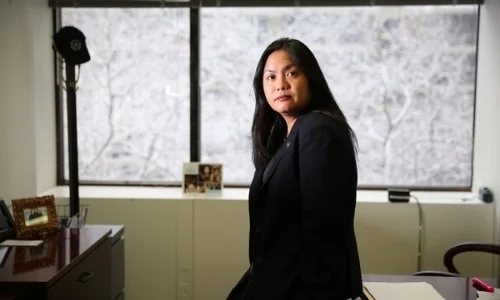
Appointed by New York City Mayor Bill de Blasio, Carmelyn is committed to cleaning up the Commission on Human Rights and to paying attention to the needs of the citizens of New York. Way to go, Carmelyn!
Carmelyn P. Malalis is the newly appointed leader of the Commission on Human Rights. Photo credit: Chang W. Lee/The New York Times.
So proud of Carmelyn P. Malalis, US FWN100™ '09! Appointed by New York City Mayor Bill de Blasio, she's committed to clean up the Commission on Human Rights and paying attention to the needs of the citizens of New York. Way to go, Carmelyn!
Read full article here - click here.
Every year, thousands of New Yorkers turn to the Commission on Human Rights, the city agency responsible for battling discrimination in the workplace, the housing market and beyond.
They describe sexual harassment and racial discrimination on the job, public buildings that remain inaccessible to disabled people, and landlords who refuse to rent to people who receive public assistance.
Then they wait. And wait. And wait.
“I get that folks want to see results,” Ms. Malalis, a 40-year-old lawyer who specializes in workplace discrimination cases, said in an interview. “I know that we’re going to do some great work here.”